Google Ads is one of the most effective ways for businesses to reach potential customers when they are actively searching for products or services. Unlike organic SEO, which can take time to produce results, Google Ads can place your business in front of relevant users almost immediately. For beginners, however, understanding how campaigns, keywords, bidding, and targeting work is essential for avoiding unnecessary spending.
What Is Google Ads?
Google Ads is an online advertising platform that allows businesses to display advertisements across Google Search and other Google properties. Advertisers generally pay when someone interacts with their ad, depending on the campaign and bidding strategy.
The most common format for beginners is Search Ads, which appear when users search for specific keywords.
1. Start With a Clear Goal
Before creating a campaign, decide what you want to achieve. Your objective might be generating leads, increasing website sales, receiving phone calls, or driving traffic to a specific landing page.
A clear goal helps determine your campaign structure, targeting, and measurement strategy.
2. Choose Relevant Keywords
Keywords connect your advertisements with user searches. Focus on terms that closely match what your business offers.
For example, a digital marketing agency might target keywords such as:
- digital marketing agency
- SEO services
- Google Ads agency
- social media marketing services
Avoid choosing keywords only because they have high search volume. Relevance and commercial intent are often more important.
3. Understand Keyword Match Types
Google Ads provides different ways to control how closely a user’s search must match your keyword. Beginners should understand broad match, phrase match, and exact match and use them according to their campaign goals.
Regularly reviewing actual search terms can also help identify irrelevant searches and improve targeting.
4. Write Strong Ad Copy
Your advertisement should clearly communicate what you offer and why users should choose you. Include relevant keywords naturally, highlight benefits, and use a clear call to action.
For example:
Get Professional SEO Services
Improve your website visibility with practical SEO strategies. Get started today.
5. Create a Relevant Landing Page
Sending every visitor to your homepage is not always the best approach. Your landing page should closely match the advertisement and keyword that brought the visitor there.
A good landing page should be fast, mobile-friendly, easy to understand, and focused on one primary action.
6. Set a Realistic Budget
Start with a budget you can comfortably monitor. Google Ads performance depends on factors such as competition, keywords, location, industry, and bidding strategy.
Instead of increasing spending immediately, first determine which keywords, ads, and campaigns are generating valuable results.
7. Track Conversions
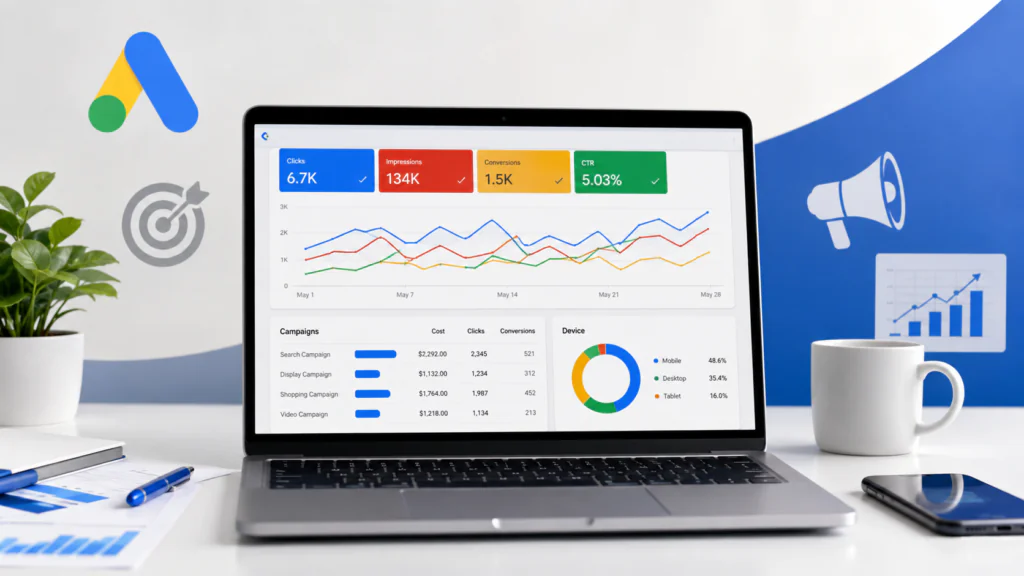
Clicks alone do not tell you whether your advertising is successful. Set up conversion tracking to measure valuable actions such as purchases, form submissions, calls, or sign-ups.
This allows you to optimize campaigns based on business results rather than traffic alone.
8. Monitor and Optimize Regularly
Google Ads should not be treated as a “set it and forget it” platform. Review search terms, keywords, ads, conversions, and spending regularly.
Pause or adjust underperforming elements and invest more carefully in areas producing strong results.
Conclusion
Google Ads can be a powerful growth channel for beginners when campaigns are built around clear goals, relevant keywords, compelling advertisements, focused landing pages, and accurate conversion tracking. Start small, measure your results, and continuously optimize your campaigns. With consistent testing and learning, you can build Google Ads campaigns that generate meaningful traffic, leads, and sales.
5 FAQs About Google Ads
1. What is Google Ads?
Google Ads is Google’s online advertising platform that allows businesses to promote their products and services to relevant audiences.
2. How much does Google Ads cost?
There is no single fixed price. Costs depend on factors such as keywords, competition, location, industry, bidding, and campaign settings.
3. Is Google Ads suitable for beginners?
Yes. Beginners can start with a small, controlled campaign and gradually improve performance by monitoring keywords, ads, and conversions.
4. What is a Google Ads keyword?
A keyword is a word or phrase used to help determine which searches may trigger an advertisement.
5. How can I improve Google Ads performance?
Focus on relevant keywords, strong ad copy, high-quality landing pages, accurate conversion tracking, and regular campaign optimization.