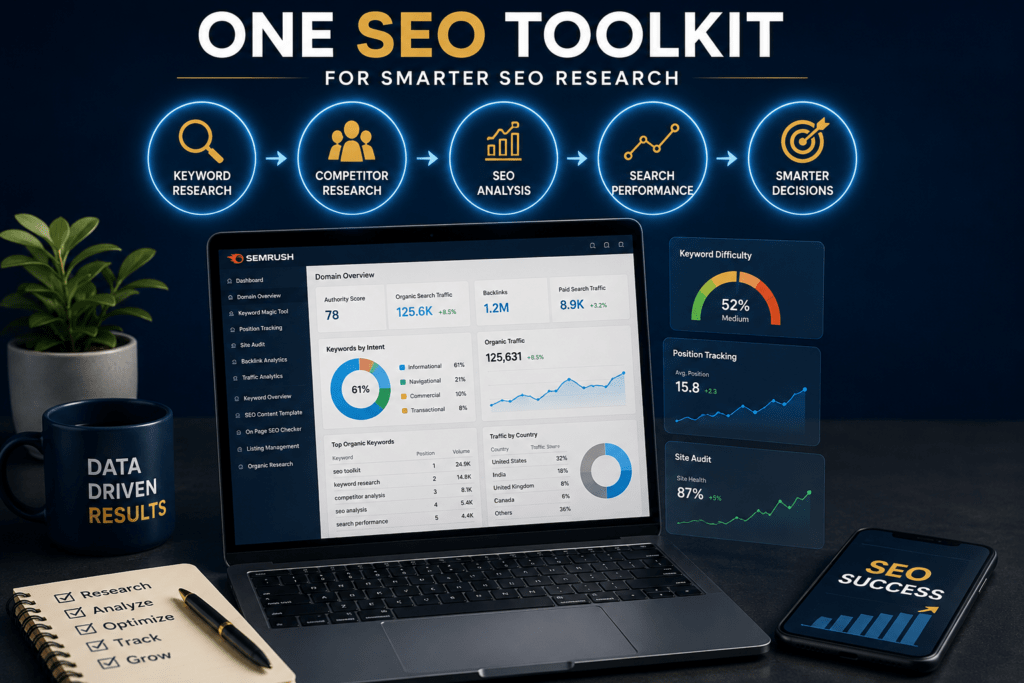
SEO research can become time-consuming when you have to switch between multiple platforms for keywords, competitors, traffic data, and search performance. A well-organized SEO toolkit can make this process much easier by bringing important research activities into one workflow.
For marketers, bloggers, business owners, and beginners, Semrush is one platform that can be used to support different areas of SEO research. Instead of relying on separate tools for every task, you can use an integrated SEO workflow to research keywords, analyze competitors, and identify opportunities for organic growth.
Keyword Research
Keyword research is the foundation of an effective SEO strategy. Before creating content, you need to understand what your target audience is searching for.
An SEO toolkit can help you discover relevant keywords and evaluate metrics such as search volume and keyword difficulty. Instead of choosing keywords simply because they have high search volume, look for terms that match your audience’s needs and the purpose of your content.
For beginners, combining primary keywords, long-tail keywords, and related search terms can create a stronger content strategy.
Competitor Research
Understanding your competitors can reveal valuable SEO opportunities. Competitor research allows you to identify the keywords they target, the content they create, and the areas where they are performing well.
Rather than copying competitors, use their strategies as research. Look for content gaps, unanswered questions, and topics where your website can provide a more useful and relevant experience.
SEO Analysis
SEO analysis helps you understand how effectively your website and content are performing. Important areas to monitor include organic visibility, keyword performance, technical issues, and content opportunities.
Regular analysis is important because SEO is not a one-time task. Search behavior, competitors, and search results can change over time.
Search Performance
Tracking performance helps you understand whether your SEO efforts are moving in the right direction. Instead of focusing only on rankings, consider broader indicators such as organic traffic, impressions, clicks, and keyword visibility.
The goal is to turn SEO data into actionable decisions. If a page receives impressions but few clicks, for example, you may need to improve its title or search-result presentation. If a page is gaining traffic, you can look for opportunities to strengthen it with better content and internal links.
Build a Smarter SEO Workflow
The biggest advantage of using an integrated SEO toolkit is efficiency. You can move from keyword research → competitor analysis → content planning → SEO optimization → performance tracking without treating each activity as a completely separate process.
However, tools are only part of successful SEO. The data you collect needs to support useful content, strong user experience, technically sound websites, and a clear understanding of search intent.
Whether you are a beginner building your first website or a marketer managing multiple projects, creating a structured SEO research process can save time and improve decision-making.
Start with the fundamentals, analyze consistently, and use SEO data to make smarter content and optimization decisions.
5 FAQs
1. What is an SEO toolkit?
An SEO toolkit is a collection of tools used for activities such as keyword research, competitor analysis, website optimization, content research, and performance tracking.
2. Why is SEO research important?
SEO research helps you understand what people search for, what competitors are doing, and where opportunities exist to improve your website’s organic visibility.
3. Is Semrush useful for SEO research?
Yes. Semrush provides a range of SEO research capabilities that can support keyword research, competitor analysis, SEO analysis, and search-performance research.
4. What should beginners research first?
Beginners should start with search intent, relevant keywords, competitors, and content opportunities before moving into more advanced SEO analysis.
5. Can one SEO toolkit replace every SEO tool?
Not necessarily. An integrated platform can cover many SEO tasks, but the best toolkit depends on your website, goals, budget, and the depth of analysis you need.