
Search engine optimization (SEO) can feel complicated when you are just getting started. From keyword research and search trends to understanding website performance, there are many areas to learn. The good news is that beginners do not need an expensive SEO software stack to start improving their website.
Several free and freemium SEO tools can help you research keywords, understand what people are searching for, analyze opportunities, and build a stronger organic traffic strategy. Here are 10 useful SEO tools for beginners in 2026.
1. Google Keyword Planner
Google Keyword Planner is a useful starting point for keyword research. It can help you discover keyword ideas and understand search demand. Beginners can use it to build an initial list of keywords for content, blogs, and advertising campaigns.
2. Google Trends
Google Trends helps you explore how search interest changes over time. You can compare topics, identify growing trends, and discover seasonal opportunities. It is particularly useful when deciding which topics may be worth creating content around.
3. Google Search
Sometimes the simplest SEO research method is Google itself. Search your target keyword and study the results, related searches, autocomplete suggestions, and common questions. This can help you understand search intent and identify content opportunities.
4. Google Search Console
Google Search Console provides valuable information about how your website performs in Google Search. You can monitor search queries, clicks, impressions, indexing issues, and other performance signals.
5. Ubersuggest
Ubersuggest offers keyword research and SEO analysis features designed to make SEO research easier. Beginners can use it to discover keyword ideas and explore content opportunities.
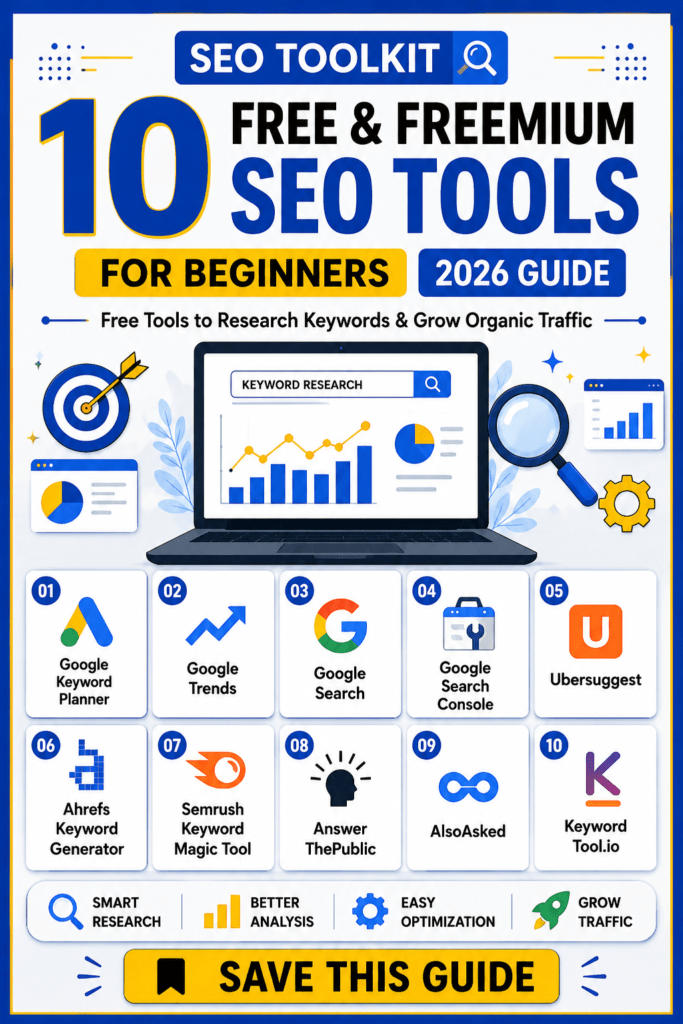
6. Ahrefs Keyword Generator
Ahrefs provides keyword discovery tools that can help generate keyword ideas. It can be useful when you need additional variations and related search terms for your content strategy.
7. Semrush Keyword Magic Tool
Semrush’s Keyword Magic Tool can help marketers discover keyword ideas and organize opportunities around different search terms. It is especially useful when you want to expand your keyword research beyond a small list of terms.
8. AnswerThePublic
AnswerThePublic focuses on questions and phrases people search around a topic. This makes it useful for generating blog ideas, FAQ sections, and content topics based on user interests.
9. AlsoAsked
AlsoAsked helps explore related questions that users may search around a particular topic. These question relationships can provide useful ideas for building comprehensive content.
10. Keyword Tool.io
Keyword Tool.io can generate keyword suggestions based on search autocomplete data. It can be useful for discovering long-tail keyword variations and expanding your content research.
Build Your SEO Toolkit
You do not need to use every SEO tool at once. Start with a few that match your current goals.
For example, use Google Search and Google Trends for topic discovery, Google Keyword Planner and Ubersuggest for keyword research, and Google Search Console for monitoring your website’s search performance. As your SEO skills grow, you can add advanced platforms such as Ahrefs or Semrush.
The most important thing is not the number of tools you use—it is how effectively you turn the information into useful, search-focused content.
With the right combination of free and freemium SEO tools, beginners can research smarter, optimize better, and gradually build a sustainable organic traffic strategy.
5 FAQs
1. What is the best free SEO tool for beginners?
Google Search Console is one of the most valuable free tools for website owners because it provides direct insights into how their site performs in Google Search.
2. Can I do SEO without paying for expensive tools?
Yes. Beginners can perform substantial SEO research using free tools such as Google Search, Google Trends, Google Search Console, and free versions of various SEO platforms.
3. Which tool is best for keyword research?
There is no single best tool for every situation. Google Keyword Planner, Ubersuggest, Ahrefs Keyword Generator, Semrush Keyword Magic Tool, and Keyword Tool.io can all help with keyword discovery.
4. How do SEO tools help increase organic traffic?
SEO tools provide data and insights that can help you identify relevant keywords, understand search behavior, discover content opportunities, and monitor website performance. Tools themselves do not guarantee higher rankings.
5. Should beginners use multiple SEO tools?
Yes, but start small. Using 2–4 complementary tools is usually easier than trying to learn every platform at once. Add more tools as your SEO requirements become more advanced.