
Search Engine Optimization (SEO) is one of the most effective ways to grow your website organically. However, even well-designed websites often fail to rank because they make a few critical SEO mistakes. These mistakes reduce visibility, lower search rankings, and ultimately decrease organic traffic.
The good news is that most SEO issues are easy to identify and fix once you know what to look for.
In this guide, we’ll cover three of the most common SEO mistakes that hurt website performance and explain how you can avoid them to improve your Google rankings.
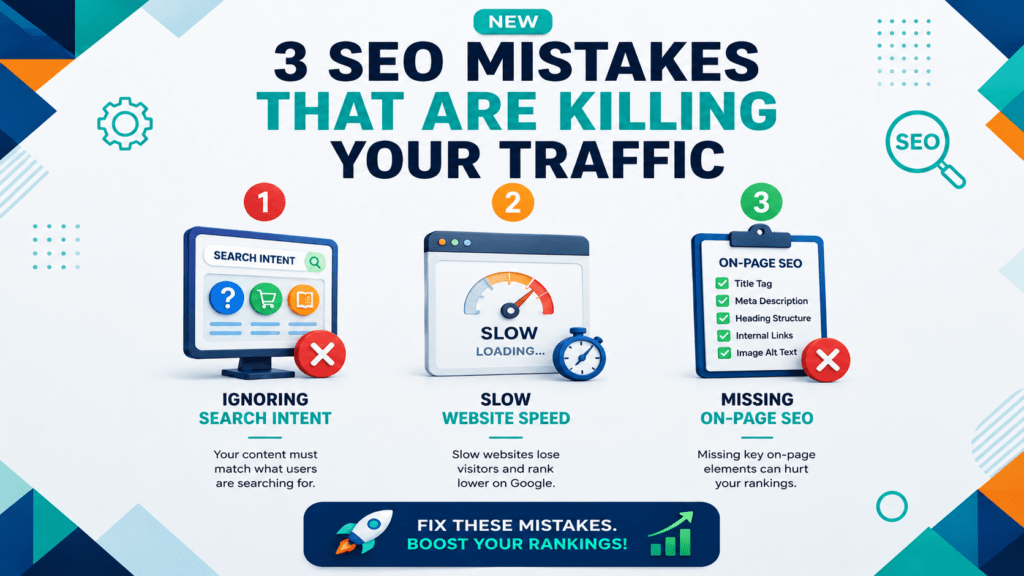
1. Ignoring Search Intent
One of the biggest SEO mistakes is focusing only on keywords while ignoring what users actually want.
Google’s algorithm is designed to understand search intent—the reason behind a user’s search. If your content doesn’t match that intent, ranking becomes much more difficult, even if you’ve targeted the right keyword.
For example, someone searching for “best SEO tools” expects a list of recommendations, while someone searching “how SEO works” wants an educational guide.
How to Fix It
Before creating content:
- Understand the user’s goal.
- Analyze the top-ranking pages on Google.
- Match your content format with search intent.
- Answer the user’s question clearly and completely.
Content that satisfies user intent keeps visitors engaged longer and sends positive ranking signals to Google.
2. Slow Website Speed
Website speed has become one of Google’s most important ranking factors. Visitors expect pages to load within seconds. A slow website creates a poor user experience, increases bounce rates, and reduces conversions.
Google also measures website performance using Core Web Vitals, making speed optimization essential for SEO success.
How to Fix It
Improve your website speed by:
- Compressing images before uploading.
- Using modern formats like WebP.
- Enabling browser caching.
- Reducing unnecessary JavaScript and CSS.
- Using a Content Delivery Network (CDN).
- Choosing reliable hosting.
A faster website improves user satisfaction while increasing your chances of ranking higher in search results.
3. Missing On-Page SEO
Many websites publish great content but forget basic on-page SEO optimization.
Without proper optimization, search engines struggle to understand your pages, reducing their visibility.
Important on-page SEO elements include:
- SEO-friendly Title Tags
- Meta Descriptions
- Proper Heading Structure (H1–H3)
- Internal Linking
- Image Alt Text
- Optimized URLs
- Keyword Placement
Ignoring these fundamentals can prevent even high-quality content from reaching its full ranking potential.
How to Fix It
Create an on-page SEO checklist before publishing every article.
Ensure each page includes:
- One clear H1 heading
- Optimized title and meta description
- Relevant internal links
- Descriptive image ALT text
- Clean URL structure
- Proper keyword placement
- Easy-to-read formatting
Following a consistent checklist improves crawlability, user experience, and search visibility.
Final Thoughts
SEO success doesn’t depend on complicated tricks—it depends on avoiding common mistakes and consistently following best practices.
By focusing on user search intent, improving website speed, and optimizing every page with proper on-page SEO, you’ll create a stronger foundation for long-term organic growth.
Remember that SEO is a continuous process. Regularly audit your website, monitor performance in Google Search Console, and update your content to stay competitive.
Fix these three mistakes today, and you’ll be well on your way to better rankings, more traffic, and higher conversions.
Frequently Asked Questions (FAQs)
1. What is the biggest SEO mistake beginners make?
Ignoring user search intent is one of the most common mistakes. Content should answer what users are actually searching for, not just include keywords.
2. Does website speed affect Google rankings?
Yes. Website speed and Core Web Vitals are confirmed ranking signals that influence both user experience and SEO performance.
3. What is On-Page SEO?
On-Page SEO involves optimizing elements such as title tags, meta descriptions, headings, internal links, image ALT text, and URL structure to help search engines understand your content.
4. How often should I perform an SEO audit?
A complete SEO audit every 3–6 months is recommended, with regular monitoring through Google Search Console and Google Analytics.
5. Can fixing these three mistakes improve rankings?
Yes. While SEO involves many factors, correcting these issues can significantly improve crawlability, user experience, and your chances of achieving higher Google rankings.