
Ranking on Google’s first page is no longer about adding a few keywords to your content. In 2026, Google’s algorithm evaluates hundreds of ranking signals to determine which pages deserve the top positions. If you want consistent organic traffic, you need to focus on the ranking factors that truly matter.
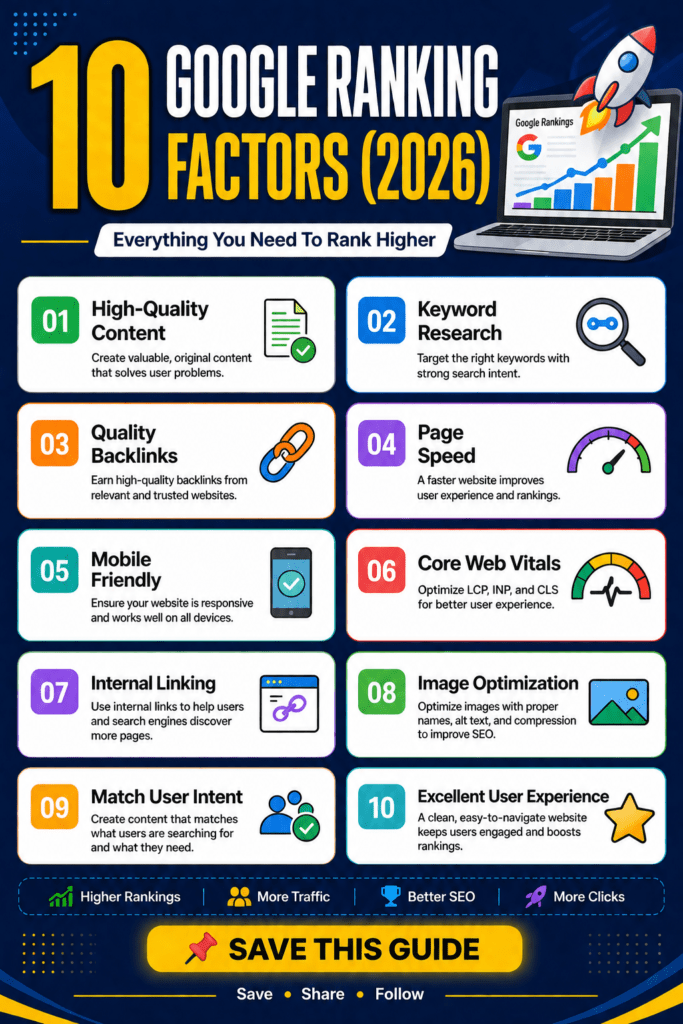
This guide covers the ten most important Google ranking factors that every website owner, blogger, digital marketer, and business should understand.
1. Publish High-Quality Content
Content remains the foundation of SEO. Google prioritizes pages that provide valuable, original, and helpful information to users.
Your content should:
- Solve a user’s problem
- Be accurate and up-to-date
- Cover the topic in depth
- Include clear headings and formatting
- Match user search intent
Helpful content naturally earns better engagement and higher rankings over time.
2. Perform Keyword Research
Before creating content, identify the keywords your audience is searching for.
Focus on:
- Primary keywords
- Long-tail keywords
- Low-competition opportunities
- Search intent
- Related semantic keywords
Using the right keywords helps search engines understand your content and connect it with relevant searches.
3. Build Quality Backlinks
Backlinks remain one of Google’s strongest ranking signals.
High-quality backlinks from trusted websites increase your site’s authority and credibility. Instead of buying links, focus on earning them through valuable content, guest posting, digital PR, and resource pages.
Quality always matters more than quantity.
4. Improve Page Speed
Users expect websites to load quickly. A slow website increases bounce rates and negatively impacts user experience.
Improve speed by:
- Compressing images
- Using browser caching
- Enabling lazy loading
- Using a CDN
- Minimizing unnecessary scripts
A fast website benefits both users and search engines.
5. Make Your Website Mobile-Friendly
Most Google searches now happen on mobile devices.
Your website should:
- Adapt to every screen size
- Have readable text
- Use responsive design
- Offer easy navigation
- Load quickly on smartphones
Google primarily indexes the mobile version of your website, making mobile optimization essential.
6. Optimize Core Web Vitals
Core Web Vitals measure real user experience.
The three key metrics are:
- Largest Contentful Paint (LCP) – Loading speed
- Interaction to Next Paint (INP) – Responsiveness
- Cumulative Layout Shift (CLS) – Visual stability
Improving these metrics helps create a smoother browsing experience and can positively influence rankings.
7. Use Strong Internal Linking
Internal links help search engines discover pages while guiding visitors to related content.
A smart internal linking strategy:
- Improves crawlability
- Passes SEO value between pages
- Increases page views
- Keeps visitors engaged longer
Always use descriptive anchor text that clearly explains the destination page.
8. Optimize Images for SEO
Images can generate additional traffic when optimized correctly.
Best practices include:
- Descriptive file names
- ALT text
- Image compression
- Modern formats like WebP
- Appropriate image sizes
Optimized images improve both page speed and accessibility.
9. Match User Search Intent
Google’s goal is to provide the most relevant result for every search query.
Understand whether users want:
- Information
- A product
- A comparison
- A service
- A specific website
Creating content that aligns with search intent significantly improves your chances of ranking.
10. Deliver an Excellent User Experience
User experience influences how visitors interact with your website.
Focus on:
- Clean website design
- Easy navigation
- Readable typography
- Clear calls-to-action
- Secure HTTPS connection
- Minimal intrusive popups
When users stay longer and engage with your content, Google receives positive signals about your page quality.
Final Thoughts
Google’s ranking algorithm continues to evolve, but these ten SEO factors remain fundamental for long-term success. Instead of chasing shortcuts, focus on creating valuable content, optimizing technical performance, and delivering an outstanding user experience.
SEO is a long-term strategy, but by consistently improving these ranking factors, your website can achieve better visibility, increased organic traffic, and higher search rankings in 2026 and beyond.
SEO FAQs
1. What are Google ranking factors?
Google ranking factors are the signals Google uses to determine where a webpage appears in search results. They include content quality, backlinks, page speed, mobile usability, Core Web Vitals, and many other SEO elements.
2. Which Google ranking factor is the most important?
High-quality, helpful content remains one of the most important ranking factors because it directly satisfies user intent and encourages engagement.
3. Do backlinks still matter for SEO in 2026?
Yes. High-quality backlinks from authoritative websites continue to be one of Google’s strongest trust and authority signals.
4. How do Core Web Vitals affect rankings?
Core Web Vitals measure loading performance, responsiveness, and visual stability. Better scores improve user experience and can contribute to stronger SEO performance.
5. How long does it take to improve Google rankings?
SEO results typically take 3–6 months, depending on competition, website authority, content quality, and optimization efforts. Consistency is the key to long-term success.